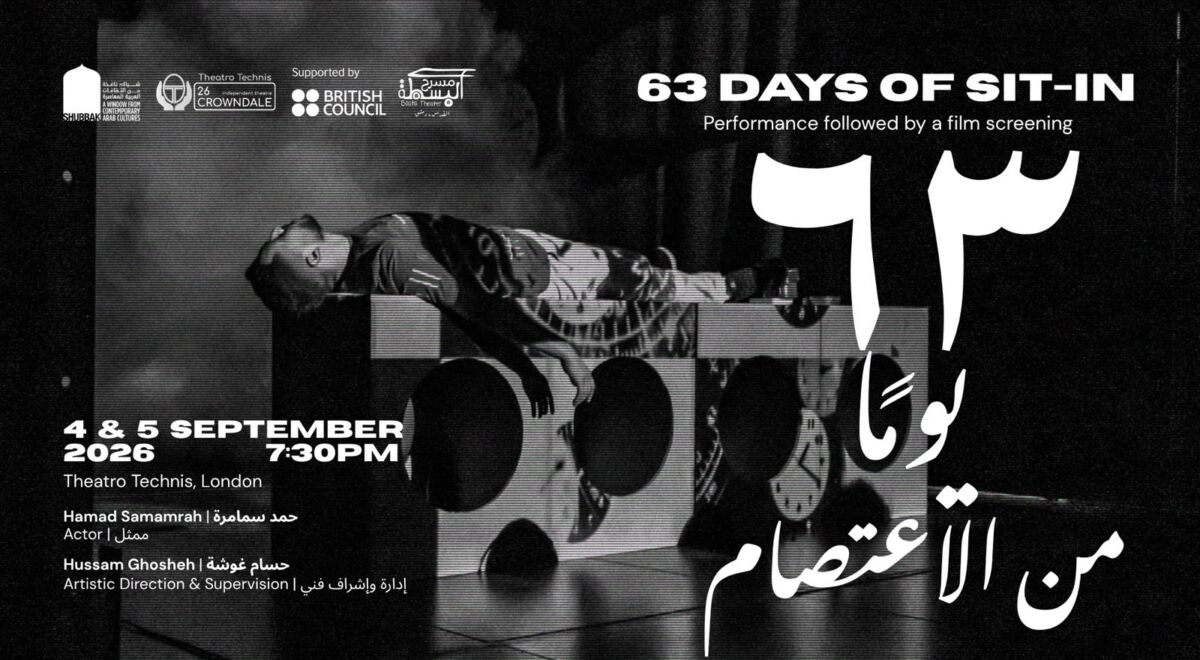
Hamad Samamrah’s body carries the cellular memory of those 63 days in 2020, when he and other disabled activists and artists sat in protest, demanding universal health insurance and refusing to be erased by the COVID 19 pandemic. That this body marked by struggle will soon occupy a UK stage is a feat that makes theatre feel undeniably alive.
His journey to the UK was not by any means easy. When we first started writing this, Hamad and his wife were preparing to cross one of the world's most heavily surveilled borders. Before they reached this point, they had faced visa rejections that dampened our hearts, only to see them reversed and our hope in bringing the performance restored. This fragility is the reality for so many artists we invite from Palestine. Whether they make it through is often out of their hands. And for a disabled body to have to endure such suffocating controls, excruciatingly long waits, and humiliating interrogation is a burden few can fathom.
63 Days of Sit-In holds the intersectional threads of disability and occupation. Created by Basta Theatre Collective under the artistic leadership of Hussam Ghosheh, the piece braids archival material, collective research, and Hamad’s lived experience into one profound theatrical journey. It reminds us that in Palestine, the architecture of occupation disables just as surely as it occupies. You cannot dismantle one without confronting the other. As asserted by Hamad, ‘We carried out this sit-in with the help of everyone: our colleagues, everyone who stood with us. And it succeeded; it reached the goal we hoped for. Now, this same sit-in is documenting its own experience, so people can learn from it, so people can see how rights-based work is built, and how it succeeds."
When we came together as Shubbak and Basta, we wanted to move as a single collective body and extend the existing work. This is the power of collaboration. Working alongside colleagues at British Council MENA, who have done phenomenal work amplifying disability arts in the region, including partnerships with Art to Heart - Palestine in Nablus and partnering with Shubbak & Sync Leadership to launch the leadership program Sync Arabi, we conspired to enhance the performance with an aesthetics of access. Because Hamad is visually impaired, access was already integral to the creative process; the set was designed specifically so he could move comfortably and safely on stage, and the touch tour component was already implemented in previous presentations in Germany. Shubbak’s task now became to ensure that this inclusivity extends to the audience, transforming what could be a checkbox into a core dramaturgical element.
So, here is what we built around Hamad’s extraordinary testimony:
Audio Description & Touch Tours
We partnered with Willie Elliott, supported by Sync Leadership, to provide audio description on the Friday 4 September presentation. This ensured that blind and low-vision audiences could sense the visual language of the performance through words. We also offered a touch tour an hour before the show began. This allowed blind and visually impaired audience members to hold the props, feel the textures of the set, and map the physical geography of the world Hamad inhabits. It transformed the abstract into the tangible, the seen into the felt.
Dramaturgy of Access
Creative producer Dais Hale from The Hale joined the rehearsal process to infuse a dramaturgy of access approach into the production. This meant looking at how the structure of the performance itself can be made accessible by questioning how the story is told, paced, and experienced. While our time only allowed for a lighter touch than a full overhaul, it introduced vital conversations about pacing and sensory load that enriched the final product.
Relaxed Performances
Both nights were relaxed performances. We lowered the lights, and welcomed the audience to fidget, move, and make sound. We wanted the space to breathe, so that neurodivergent audiences and those with sensory sensitivities could be present without having to perform compliance. Neurospicy joy demands a different rhythm of engagement, and we moved to honor that.
Captions
The performance was delivered in the Arabic language with English closed captions. While we would have loved to incorporate more stylised creative captioning, we had limited time and didn’t want to bolt this on. The closed captions were there, and the creative captioning is waiting.
Venue Access
Theatro Technis is fully wheelchair accessible. Guide dogs and hearing dogs were welcome in the auditorium. A Loop system was fitted in the main hall.
Companion Tickets
Anyone who required accompaniment for access reasons was offered a complimentary additional ticket at no cost.
When we center disability justice alongside Palestinian liberation, we dream of a different economy. We dream of a theatre filled with disabled people moving through space with dignity and ease, unapologetically claiming their right to simply be. Beside them are those moving for the safety of Palestinian people, and their right to land and a dignified life. This is a space of shared recognition that our freedoms are inextricably linked in a coalition of the joyful and the defiant, where liberation is a practice we enact every time we assert that we belong, together.
—-------------------------------------
A word from Hamad Samamrah
To me, reaching a stage in the United Kingdom is not simply a Palestinian performance moving from one country to another, nor do I see it as a recognition without which the value of our experience remains incomplete. The value of this experience was born in Palestine — from our bodies, our voices, and from 63 days in which we refused to be invisible. But this performance reaching here means that we have succeeded, even if temporarily, in breaking the isolation imposed on Palestinians, and in carrying our story across borders that try to control our movement, our ability to speak, and our ability to reach the world.
I do not stand on stage as a blind person in need of pity, but as an artist, an activist, and someone with a complete political experience. Disability is not a personal tragedy, and accessibility is not an extra service granted to us out of kindness; it is a right, and a redistribution of power within theatre and within society. When a performance becomes accessible, we change the definition of who has the right to make art, who has the right to experience it, and who is allowed to be at the centre of the story.
And in Palestine, disability cannot be separated from the colonial reality we live under. Occupation does not only place obstacles in front of people with disabilities; it produces new disabilities through multiple levels of violence, then multiplies their effects by destroying the healthcare system, restricting movement, and blocking access to treatment, rehabilitation, and assistive devices. What is happening in Gaza reveals this truth in its harshest form: bodies wounded, limbs amputated, people denied the means of survival and treatment, then expected to fend for themselves amid the rubble and displacement.
This is why I do not want the audience to leave the performance moved by my story alone. I want them to ask: what structure made this sit-in necessary? Who decides which bodies are allowed to cross, which voices reach the stages, and which lives are treated as postponable or dispensable? 63 Days of Sit-In is an on-going invitation, a living archive to turn solidarity from a passing feeling into a position, a practice, and an act of accountability.
To me, true liberation means changing the system that produced exclusion in the first place. I do not want a marginal seat in an unjust theatre; I want us to rebuild the theatre itself, so that no one has to prove they deserve to enter, apologise for their body, or ask permission to tell their story.